

Cultivating Leadership Qualities in IT Staff
Key Takeaways
- Leadership in IT roles isn’t limited to managers: it’s a quality that can be developed at any level.
- IT succession planning helps avoid future talent gaps and promotes continuity.
- Identifying leadership potential requires looking beyond job titles and credentials.
- Core leadership skills for IT include communication, decision-making, adaptability, and systems thinking.
- Developing future leaders means offering real growth opportunities, training, and mentorship.
What Does Leadership Really Look Like Inside a Technical Team?
For many organizations, leadership still gets defined by job titles or direct reports. That gap creates risk. When companies treat leadership as a position instead of a capability, teams miss early signals of potential. Succession planning becomes reactive and continuity suffers.
If you want stability, scalability, and stronger execution, you need a deliberate approach to cultivating leadership qualities in IT staff. That starts with redefining what leadership means in technical roles, identifying potential early, and putting repeatable systems in place to develop leaders from within.
Redefining Leadership for Modern IT Teams
Leadership inside IT teams has evolved. Technical depth still matters, but leadership now centers on influence, clarity, and decision-making under pressure.
When leadership is narrowly defined, organizations overlook professionals who already guide outcomes without formal authority. Expanding that definition helps you surface future leaders earlier and reduce dependency on a small leadership group.
Why Leadership Isn’t Just for Managers
Many IT professionals lead well before they ever manage people. You see it when someone owns an incident response without being asked, translates complex issues for business partners, or quietly mentors a peer through a new technology. None of those roles carry a title, but all of them move the work forward.
These behaviors reduce friction and signal something important: This person is invested. When your organization recognizes and names that contribution early, it creates a clearer growth path for the individual and gives them a reason to stay. A developer who sees a future at your company is far less likely to take a recruiter’s call.
The Value of Distributed Leadership in Technical Environments
There’s also a practical benefit of leadership training for the managers above them. When teams develop informal leaders, formal managers spend less time fielding every question and firefighting every incident.
The load distributes naturally, and the team scales without requiring a new layer of management every time complexity increases.
In technical environments especially, distributed leadership improves both resilience and decision speed. Complex problems rarely have a single owner. Teams that spread responsibility across experienced people move faster and recover better when something goes wrong.
Bottlenecks form when authority concentrates. Momentum builds when more people feel ownership over outcomes.

Creating a Succession Plan That Works
Leadership development often becomes urgent only after someone leaves. At that point, options are limited.
Effective IT succession planning treats leadership as a pipeline. The goal is continuity, clarity, and preparedness, all of which help you avoid last-minute replacements.
Why Every IT Department Needs One
IT roles often concentrate institutional knowledge. When a lead architect or systems owner exits unexpectedly, projects stall and risk increases.
Succession planning minimizes that exposure by clarifying who can step in and what development is required before the transition happens.
Mapping Key Roles and Leadership Dependencies
Start by identifying roles that create single points of failure, including:
- Platform or application owners
- Senior engineers responsible for core systems
- Technical leads interfacing with business stakeholders
From there, assess readiness and development gaps.
How to use this chart: Rate each role red, yellow, or green on backup readiness so the table translates directly into action: Red indicates no reliable backup, Yellow signals a partial or untested backup, and Green reflects fully tested coverage with clear ownership.
Use this color-coding to highlight potential single points of failure, reinforcing that the goal of succession planning is to reduce role-based risk and protect continuity, not just update an org chart.
How to Identify Leadership Potential Early
Leadership potential rarely announces itself. It shows up in daily decisions and interactions.
Organizations that succeed at identifying IT leaders look beyond resumes and certifications. They pay attention to how people think and act when pressure is high.
Traits to Look for in Technical Professionals
Leadership-ready IT professionals often demonstrate:
- Ownership of outcomes, not just tasks
- Curiosity about business context
- Willingness to guide peers
- Comfort making decisions with incomplete information
These behaviors signal readiness for broader responsibility.
Questions and Assessments That Reveal Leadership Mindset
Managers can surface leadership potential by asking questions such as:
- How would you approach this if resources were constrained?
- How do you balance technical risk with business urgency?
- What tradeoffs would you communicate to leadership?
The answers reveal judgment, not just knowledge.

Essential Leadership Skills for IT Professionals
Technical expertise builds credibility. Leadership skills create influence.
The most effective IT leaders combine deep knowledge with strong interpersonal capabilities. These leadership skills for tech teams help align systems, people, and priorities.
Communication, Adaptability, and Systems Thinking
Clear communication allows leaders to translate technical decisions into business impact. Adaptability helps teams respond to shifting priorities without losing alignment.
Systems thinking enables leaders to anticipate downstream effects across platforms and teams, reducing unintended consequences.
Translating Technical Expertise Into Influence
Influence comes from trust. IT leaders earn it by listening, framing decisions around outcomes, and supporting others through change.
These soft skills for IT professionals often determine whether technical ideas gain traction.
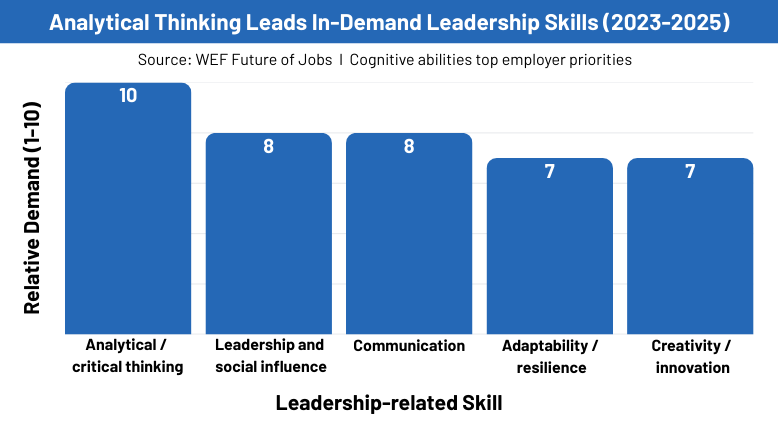
Communication and critical thinking rank among the most in-demand skills for technical leaders globally.
Training and Developing Tech Leaders
Leadership development does not happen by accident. It requires structure, opportunity, and reinforcement.
Organizations committed to developing technical leadership invest beyond certifications. They create experiences that build judgment and confidence.
Internal Development Programs and Mentorship
Mentorship accelerates growth by pairing emerging leaders with experienced professionals who provide context and feedback. This builds confidence and consistency.
Programs work best when they include measurable expectations and follow-through.
Stretch Assignments and Cross-Functional Exposure
Stretch assignments test readiness. Leading a system migration or cross-functional initiative forces professionals to balance priorities and communicate clearly.
Exposure to non-IT teams builds business awareness and credibility.
Upskilling Beyond Technical Certifications
Certifications validate expertise. Leadership development builds capability.
Training in communication, decision-making, and stakeholder management complements technical skills and prepares professionals for broader roles.
Stages of Leadership Development in IT Teams
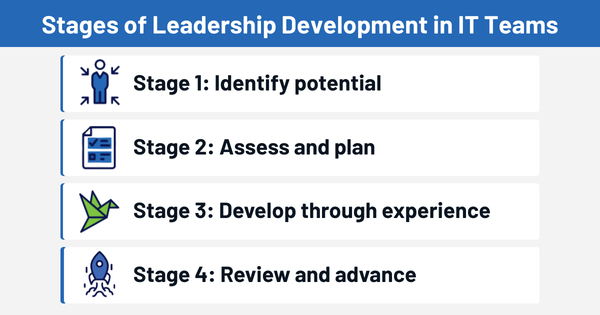
Leadership development is most effective when it follows a clear progression. Without structure, growth depends on chance rather than intention. A staged approach helps IT teams treat leadership as a pipeline, not a one-time promotion decision.
These stages provide a simple, repeatable way to identify, develop, and advance leaders while keeping succession planning visible and current.
Stage 1: Identify potential
- Spot individual contributors showing ownership, curiosity, and informal influence.
- Use manager input and basic assessments to flag emerging leaders early.
Stage 2: Assess and plan
- Define core leadership competencies (communication, decision-making, adaptability, systems thinking) by level.
- Map current strengths and gaps, then create a personalized development plan.
Stage 3: Develop through experience
- Apply a 70‑20‑10 mix: stretch assignments and cross-functional projects (70), mentoring and coaching (20), targeted courses or workshops (10).
- Emphasize rotations, incident ownership, and business-facing work for IT staff.
Stage 4: Review and advance
- Regularly review progress, refine plans, and formalize new responsibilities or titles as leaders demonstrate readiness.
- Feed outcomes back into succession plans so the pipeline stays visible and up to date
How Staffing Partners Help Build Leadership Pipelines
Internal development is essential, but it is not always sufficient on its own.
Strategic staffing partners support leadership pipelines by identifying professionals who bring both technical depth and leadership readiness.
Bringing in Leadership-Ready Talent
Experienced IT professionals can elevate teams by modeling strong communication and ownership habits. These hires often become informal mentors and stabilizers.
Supporting Growth Through Mentorship Models and Strategic Hires
Staffing partners also help design roles that blend delivery with leadership development, supporting long-term capability building.
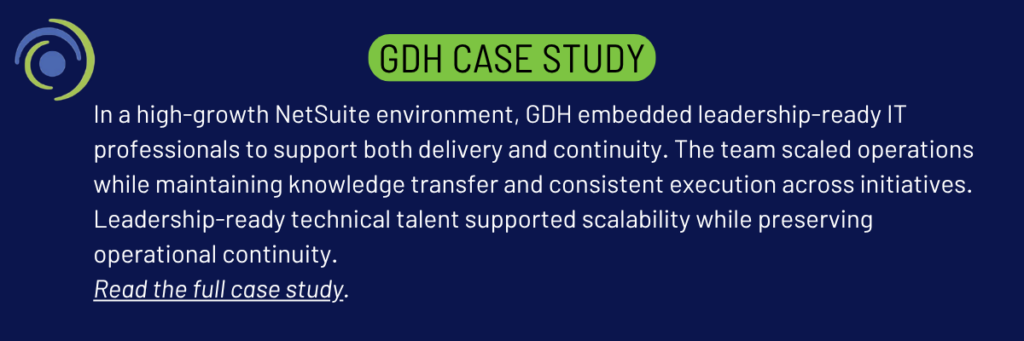
Client Success Story: Strategic Partnerships and Scalable Success in NetSuite Consulting
Next Steps
Cultivating leadership qualities in IT staff means investing in people, giving them rheumatoid to lead, and backing them with the right support.
When you clearly define leadership and plan for continuity, you strengthen your organization from the inside out.
Need help developing the next generation of IT leaders? Connect with GDH to find and grow IT professionals who lead from any level.Seeking Top Talent? We Discover It.

FAQ
What does leadership look like in technical roles?
Leadership in IT appears through ownership, influence, and clear communication, even without direct reports.
How can I start succession planning for my IT team?
Begin by identifying critical roles, assessing readiness, and aligning development plans to close gaps.
What soft skills are most important for IT leaders?
Communication, adaptability, and systems thinking are essential soft skills for IT professionals moving into leadership roles.
Can junior IT staff grow into leadership roles?
Yes. With mentorship, exposure, and structured development, junior professionals can build leadership capability over time.
How can staffing firms support IT leadership development?
They help identify leadership-ready talent and design roles that support long-term growth.
References
“Business Continuity Playbook: Critical Role Coverage for Shift Management.” Shyft, 19 May 2025, https://www.myshyft.com/blog/critical-role-coverage/
“Embrace Your Inner Incident Commander.” Increment, 18 Nov. 2021, https://increment.com/reliability/technical-incident-command/
“The Future of Jobs Report 2023.” World Economic Forum, 2023, https://www.weforum.org/publications/the-future-of-jobs-report-2023/
“The Importance of Succession Planning to IT and Information Security Resiliency.” Safe Systems, 12 Dec. 2022, https://www.safesystems.com/blog/2022/08/the-importance-of-succession-planning-to-it-and-information-security-resiliency/
“The Incident Commander Role: Duties & Best Practices for ICs.” Splunk, 6 March 2023, https://www.splunk.com/en_us/blog/learn/incident-commander-ic-role.html.
“Most In Demand Skills for Employers as We Enter 2025.” Forbes, 30 Oct. 2024, https://www.forbes.com/councils/forbestechcouncil/2024/10/30/most-in-demand-skills-for-employers-as-we-enter-2025
“Skillsoft IT Skills and Salary Report 2023.” Skillsoft, 2023, https://s3.us-east-1.amazonaws.com/skillsoft.com/prod/resources/Skillsoft-IT-Skills-and-Salary-Report-2023.pdf
“Strategic Partnerships & Scalable Success in NetSuite Consulting.” GDH, https://gdhinc.com/case-study/strategic-partnerships-scalable-success-in-netsuite-consulting/
“Succession Planning Examples – Learning From Industry Leaders.” Orgvue, 3 Aug. 2023, https://www.orgvue.com/resources/articles/succession-planning-examples-learning-from-industry-leaders/
“What Is an Incident Commander?” PagerDuty, 25 Sept. 2024, https://www.pagerduty.com/resources/incident-management-response/learn/what-is-incident-commander/
“What Is Single Point of Failure?” Training Camp, 31 Aug. 2025, https://trainingcamp.com/glossary/single-point-of-failure
“4 Golden Rules of Fact-based Succession Planning.” Visier, 5 Dec. 2022, https://www.visier.com/blog/succession-planning-success-golden-rules-future-proofing-business