

AI Interview Preparation: What to Expect When Your First Interview Is with an AI
Key Takeaways
- AI interviews follow a predictable structure. Knowing the format reduces stress and improves performance.
- Your answers matter more than delivery style. Content and clarity outweigh charisma.
- Preparation improves outcomes. AI evaluates consistency, not improvisation.
- Humans are still involved. Most AI screenings are reviewed by people later.
- These interviews are becoming standard. Especially across technology careers and large employers.
QUICK ANSWER
AI interviews follow a set format. Prepare structured, job-focused answers and test your tech in advance so you can handle this common first screening with confidence.
If your interview invitation mentions automation, recorded responses, or digital screening, you are not alone in feeling nervous. Many candidates encounter AI interviews for the first time while actively applying for roles, especially in large organizations and regulated environments.
That uncertainty is exactly why AI interview preparation matters. When you understand what the process looks like and how responses are evaluated, the experience becomes far less stressful and far more manageable.
Why Employers Use AI for First Interviews
Employers adopt AI job screening to manage volume, consistency, and fairness. Many open roles receive hundreds to thousands of applications. Reviewing each one manually at the earliest stage is not realistic.
AI interviews allow employers to ask the same questions, in the same way, to every candidate. That consistency supports fairer comparisons and clearer documentation. That consistency is especially valuable for enterprise hiring and public-sector roles.
Importantly, AI does not replace human decision-making. It helps hiring teams prioritize which candidates move forward for deeper review.

What an AI Interview Actually Looks Like
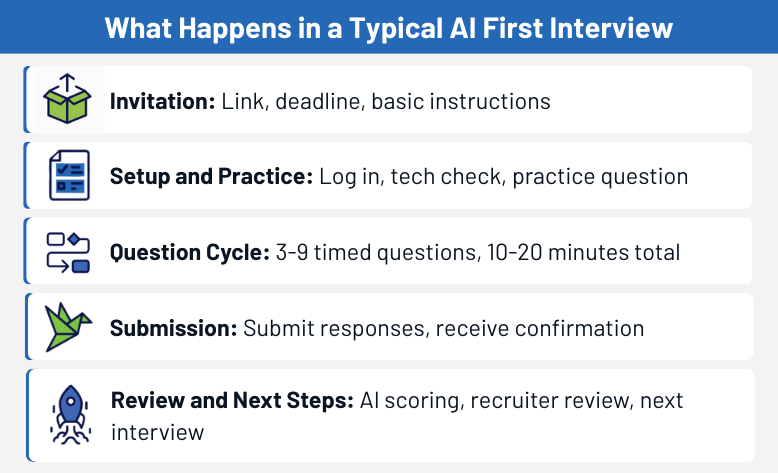
An AI interview usually begins with an email invitation. Typically, you are given a deadline and a link to complete the interview on your own schedule. This flexibility is intentional and designed to accommodate different time zones and commitments.
Before the interview starts, most platforms guide you through a setup process. You may test your camera, microphone, or typing environment. Clear instructions appear before each question.
Question formats vary. Some interviews require recorded video responses, others use audio-only prompts, and some rely on written answers. Time limits are common, and many platforms allow a short preparation window before you respond.
Compared to human interviews, this format rewards preparation. Staying focused, answering directly, and managing your time become easier when the structure is predictable.
Once you know what to expect, predictability becomes a strength rather than a limitation.
How AI Evaluates Your Responses
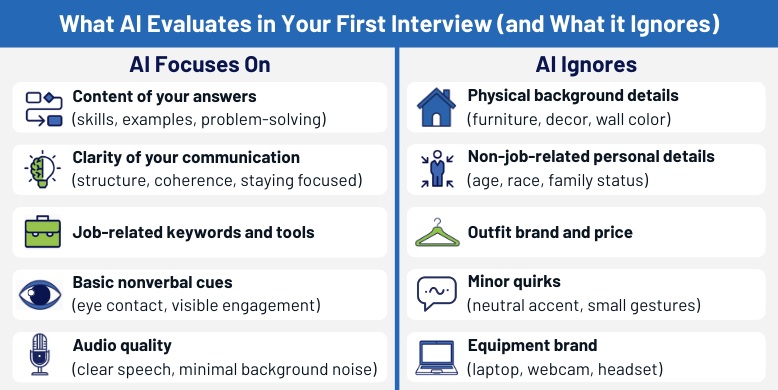
Effective AI interview preparation starts with understanding how responses are evaluated. Most systems focus on job-related content rather than presentation.
Evaluation commonly includes keyword relevance tied to the role, completeness of answers, and alignment with required competencies. Some tools also assess structure, such as whether you addressed each part of a multi-part question.
Equally important is what AI does not evaluate. Appearance, background setting, accent, and personality traits are not the focus when systems are designed responsibly.
Research from the Society for Human Resource Management shows that structured interviews are up to 2x more predictive of job performance than unstructured interviews, which is why AI tools emphasize consistency.
This knowledge allows you to prioritize clarity and relevance over performance.
How to Prepare for an AI Interview
Preparation for AI interviews is practical and repeatable. You don’t need scripts or tricks, but you do need structure.
- Review the job description. Identify required skills and responsibilities so your answers stay relevant.
- Practice structured responses. Use clear examples that demonstrate how you approach tasks or challenges.
- Choose a distraction-free environment. Quiet surroundings help you focus and stay concise.
- Test your setup in advance. Confirm your audio, camera, and internet connection before starting.
This checklist is the foundation of strong AI interview preparation. Treat the interview like a structured phone screen rather than a live conversation.
Interview prep puts you in control of a standardized process.
Special Considerations for Government and Regulated Roles
Candidates pursuing public-sector roles should expect additional structure. The government hiring process emphasizes documentation, compliance, and consistency.
AI interviews in these environments often use tightly defined questions aligned with formal job requirements. Timelines may be longer, and multiple review stages are common.
The benefit for candidates is transparency. Evaluation criteria are usually well documented, and fairness is a priority.
Knowing this context can help you manage expectations and remain patient throughout the process.
Common Myths About AI Interviews
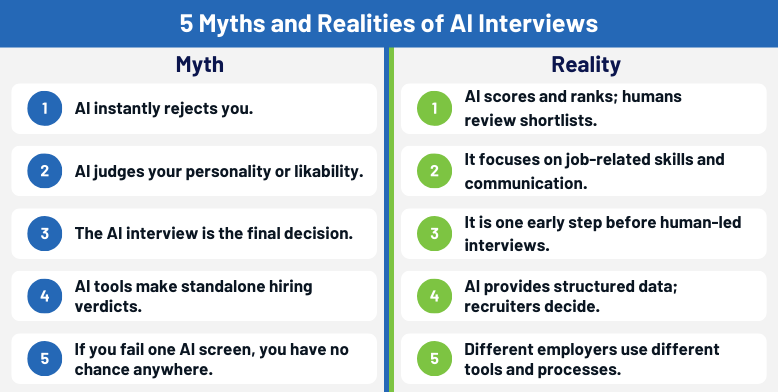
AI interviews are structured screens, not secret judges. When you know what they actually do, they feel a lot less scary.
Myth: AI interviews instantly reject you.
Reality: AI usually scores and ranks your responses so humans can review shortlists and decide who moves forward.
Myth: AI is judging your personality or “likability.”
Reality: It focuses on job‑related skills and communication, not deep personality judgments or whether you match a specific “type.”
Myth: The AI interview is the final decision.
Reality: It is rarely the last step; most employers use AI interviews as one early screen before human‑led interviews where offers are made.
Myth: AI tools make standalone hiring verdicts.
Reality: AI provides structured data and comparisons to support recruiters, who still make the actual hiring decisions.
Myth: If I do not “beat the AI,” I have no chance anywhere.
Reality: Different employers use different tools and settings, and many roles still rely heavily on human-led interviews, so one AI screen is not a verdict on your overall potential.
When you see AI as a front‑end filter that standardizes questions and surfaces strong answers, you’re likely to feel more confident throughout the process.
First AI Interview Tips
Your first AI interview doesn’t have to feel like a black box. With a little prep on your setup, your stories, and how you show up on camera, you can turn it into a structured chance to highlight your strengths.
Before the Interview
- Learn the format and timing. Check if it’s one-way video, multiple choice, or coding, and how many minutes you get per question so you can pace yourself.
- Test your tech setup. Use a stable internet connection, working webcam, and mic; do a quick test recording on the platform if possible.
- Set up a clean, quiet space. Choose a neutral background, good front lighting, and minimal noise so the system can clearly see and hear you.
- Dress like a normal video interview. Wear role-appropriate, non-distracting clothes (solid or neutral top, no busy patterns).
- Practice out loud with a timer. Rehearse answers to common behavioral and basic AI/tech questions under time constraints to reduce rambling.
During the Interview: Communication
- Use a simple structure for answers. ean on formats like STAR (Situation, Task, Action, Result) so your responses are clear and scorable.
- Keep answers concise and focused. im for 60–90 seconds on typical behavioral prompts, hitting the question directly instead of giving your full life story.
- Speak clearly and with energy. Articulate your words, vary your tone, and avoid sounding monotone so voice analysis doesn’t flag low engagement.
- Look into the camera, not the screen. Treat the camera like a person’s eyes to improve perceived eye contact and attentiveness.
- Use relevant keywords naturally. Echo important skills, tools, and technologies from the job description in your examples, without turning your answer into a buzzword list.

Content: What You Actually Say
- Prepare 4–6 strong stories in advance. Have examples ready for teamwork, conflict, failure, impact, and learning so you can plug them into different prompts.
- Show how you think, not just what you did. Briefly explain trade‑offs, why you chose a tool or approach, and what you’d do differently next time.
- Highlight measurable impact. Mention outcomes with numbers where you can (performance gains, latency improvements, bug reduction, cost savings).
- Connect your experience to their role. Tie your projects to their stack, business model, or domain (for example, how a past ML project applies to their product).
- Address AI and ethics if relevant. For AI-specific roles, be ready to talk about data quality, bias, explainability, and responsible use.
Mindset and Fairness
- Expect it to feel less “human.” Know that many candidates feel AI interviews are less fair or personal, which can increase anxiety. Remind yourself it’s just an initial screen.
- Don’t try to “game” the system. Over‑scripted answers or exaggerated emotion can backfire; aim for structured but authentic responses.
- Manage time, not perfection. If you get stuck, summarize your main point and move on rather than going silent or restarting mentally.
- Use practice platforms if available. If the employer or third-party site offers practice questions, take a full run-through to normalize the experience.
Next Steps for Candidates
If you’re exploring technology careers, learning how to approach AI interviews is now part of interview readiness. Practice structured answers, review job requirements carefully, and focus on clarity so each screen becomes one more opportunity to show your strengths.
GDH offers roles, resources, and human support to help you navigate AI job screening, from preparation through final interviews. To explore career opportunities and get support for every interview stage, start here.

FAQs
Are AI interviews fair?
When designed responsibly, AI interviews support fairness by asking the same questions and applying consistent criteria. Many employers combine AI screening with human review.
Can I redo an AI interview?
Some platforms allow retakes or practice runs. Instructions usually explain this clearly before you begin.
Do humans watch AI interview recordings?
In most cases, yes. AI helps organize responses, but people typically review shortlisted candidates.
How long do AI interviews take?
Most take 20 to 45 minutes, depending on the question format and number of questions.
Are AI interviews common in government hiring?
Yes. AI screening is increasingly used in the government hiring process to manage volume and ensure consistency.