
How to Align IT Hiring Plans with Business Growth Goals
Key Takeaways
- Growth plans should drive IT hiring decisions. When leadership connects headcount to initiative outcomes, hiring becomes a planning tool instead of a reaction.
- Workforce planning gaps are an organizational challenge. When hiring lags behind growth, the root cause is usually misaligned planning across business, HR, and IT.
- Proactive skills forecasting reduces cost and risk. Identifying capability gaps six to twelve months ahead creates real options. Waiting until a gap becomes urgent eliminates them.
- Blended workforce models give companies room to scale. Combining internal teams with external IT professionals lets organizations respond to changing demands without over-committing to headcount.
Business growth rarely stalls because demand disappears. More often, it slows when the internal systems and teams supporting it can’t keep up. For many organizations, the strain shows up first in IT, not because IT is failing, but because the hiring strategy never caught up with the growth strategy.
As transaction volumes increase, platforms stretch beyond their original design while security requirements grow. Internal teams support more users, more data, and more integrations, often without additional headcount or time to bring the right people on.
The solution is building an IT hiring strategy that reads from the same roadmap as your business growth plan.
Why Growth Plans Should Drive IT Hiring Decisions
Growth initiatives change how a business depends on technology. Expanding into new markets increases system load. Digital transformation introduces unfamiliar platforms and integrations.
Mergers and acquisitions bring new security, compliance, and data management requirements. Each shift creates specific technology needs that require specific skills.
When IT hiring isn’t connected to these initiatives, organizations tend to staff by job title instead of by outcome. Skill gaps emerge, priorities conflict, and teams get stretched during the most critical phases of growth.
Tying hiring to growth plans shifts the conversation from, “Who do we need right now?” to, “What capabilities must be in place for this initiative to succeed?”
What Happens When Hiring Lags Behind Growth
When workforce planning lags behind business strategy, a few patterns tend to repeat:
- IT roles are approved too late. Hiring cycles for specialized roles often take three to six months. Starting too late creates a gap right when the team needs to move.
- Teams lack skills for new platforms. New technology investments stall when nobody on staff knows how to operate or scale them.
- Security and compliance requirements get underestimated. Growth into new markets or through M&A brings regulatory exposure that requires dedicated expertise.
- Budgets cover short-term fixes instead of durable capability. Reactive hiring is more expensive and produces shorter tenures than planned hiring tied to specific outcomes.
Translating Growth Goals into IT Role Priorities
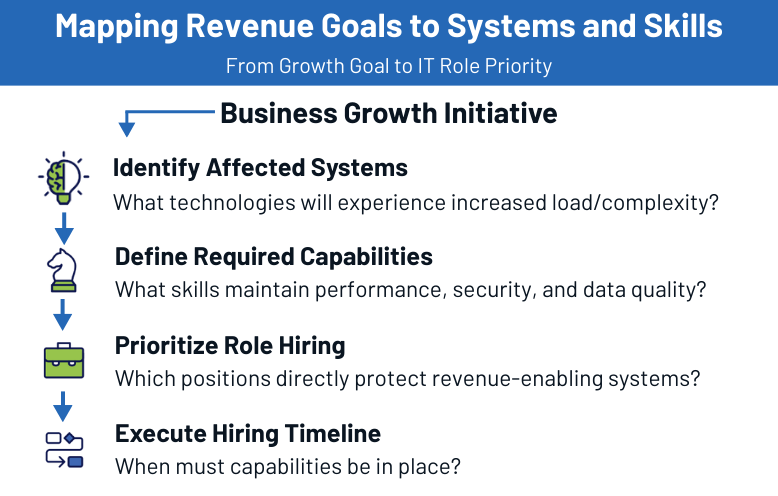
You need to translate high-level objectives into concrete technology requirements before they can inform hiring decisions. Start with the initiatives on the roadmap and work backward:
What systems will those initiatives touch? What skills does your team currently have? What’s missing? That gap is your hiring target.

Not all IT roles contribute equally during growth. Some positions directly protect the systems that enable revenue and customer trust. Roles that often become critical during growth phases include:
- Infrastructure and cloud engineers responsible for scalability
- Security professionals managing risk and compliance
- Operations roles protecting uptime and incident response
- Data engineers supporting the analytics that drive growth strategy.
Prioritize these roles to reduce disruption and improve onboarding effectiveness. Expectations are tied to specific business outcomes rather than generic job descriptions.
Building an IT Talent Strategy That Scales with the Business
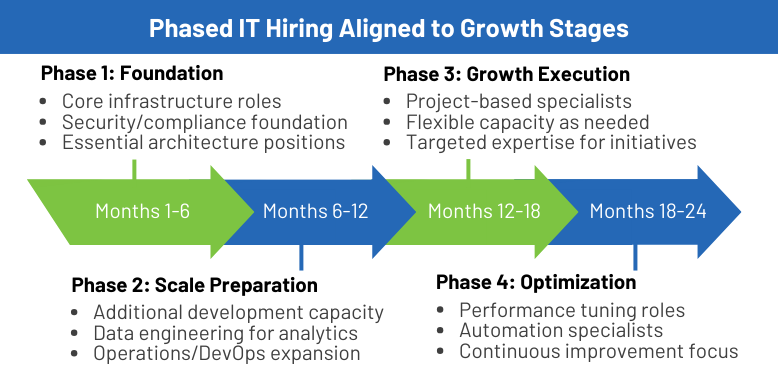
Sustainable growth requires more than filling immediate gaps. The most effective IT hiring strategies distinguish between roles that anchor the organization and roles that can flex with project demand.
Organizations may find value in prioritizing full-time resources for core roles such as IT leadership, security ownership, and foundational infrastructure. At the same time, project-specific or flexible needs, such as application development, data migrations, or peak workload support, may lend themselves well to engagement with external IT professionals, depending on business goals and timelines.
Separating these categories helps you avoid locking in headcount costs that outlive the work that justified them.
Rapid growth creates pressure to hire aggressively, and without capacity planning, that pressure pushes organizations toward two predictable problems: overstaffing once growth stabilizes, or burning out teams when elevated workloads run too long.
KPMG’s 2025 workforce research found that organizations with strong planning programs cut annual labor costs by an average of 10% through reduced attrition and better staffing decisions, a figure that reflects how much reactive hiring actually costs.
Strategic workforce planning matches hiring to actual demand. Flexible staffing absorbs short-term spikes while internal teams maintain sustainable workloads, which matters most precisely when the business is growing fastest.
Next Steps for Aligning IT Hiring with Business Goals
Aligning IT hiring with business growth is a shared responsibility across leadership, IT, and HR. Hiring managers should review upcoming initiatives regularly and assess whether current IT roles and skills are sufficient to support them.
Gaps identified six to twelve months out are far easier and far less costly to address than gaps discovered mid-execution.
With the right framework and the right partner, IT hiring becomes a growth enabler. Talk with GDH about building an IT hiring strategy that supports your business goals and scales as your needs evolve.
Frequently Asked Questions
How do you align IT hiring with business growth goals?
Start by translating growth initiatives into technology requirements, then identify the roles that protect scalability, security, and revenue performance at each phase. Involve IT, HR, and business leadership in the conversation early.
What IT roles matter most when scaling a business?
Roles that protect uptime, data, and system scalability tend to be most critical—including infrastructure, security, operations, and data-focused positions. The right answer depends on your specific growth roadmap.
When should companies start building scalable IT teams?
Before growth accelerates. For roles that are hard to fill, planning should begin six to twelve months in advance.
Should companies hire full-time IT staff or use external professionals during growth?
Both. Core infrastructure, security, and leadership roles typically warrant full-time hires. Project-based work and capacity spikes are often better suited to external IT professionals.
What is strategic workforce planning in IT?
It’s the process of forecasting skills needs, planning for attrition, and aligning hiring timelines with business objectives so IT capacity matches demand at each growth stage.
References
CompTIA. (2025). IT Industry Outlook 2025. https://www.comptia.org/en/resources/research/it-industry-outlook-2025/
Gartner. (2024). Gartner Survey Reveals That Only 48% of Digital Initiatives Meet or Exceed Their Business Outcome Targets. https://www.gartner.com/en/newsroom/press-releases/2024-10-22-gartner-survey-reveals-that-only-48-percent-of-digital-initiatives-meet-or-exceed-their-business-outcome-targets
KPMG. (2025). Rethinking Strategic Workforce Planning with AI Agents. https://kpmg.com/us/en/articles/2025/strategic-workforce-planning-with-ai-agents.html
World Economic Forum. (2025). The Future of Jobs Report 2025. https://www.weforum.org/publications/the-future-of-jobs-report-2025/digest/