
How to Prove AI Skills Without a PhD
Quick answer: You prove AI skills by showing work, not listing coursework. A portfolio of real projects documented on GitHub or a personal site demonstrates far more to hiring managers than a transcript. Certifications from providers like Google, AWS, or DeepLearning.AI add credibility, but applied work is what gets you in the room.
AI hiring is exploding, but the job descriptions haven’t fully caught up. You’ll still see “master’s degree” or “PhD preferred” listed across roles, even as companies scramble to find people who can actually build and deploy machine learning systems.
If you’re learning AI outside a formal program or you’ve already built real skills without an advanced degree, you’ve probably hit the same question: how do you prove AI skills in a way hiring managers actually trust? Not in theory, but in a way that gets you interviews.
Here’s the reality: the market has already shifted. Nearly half of tech job postings no longer require a four-year degree, signaling a move toward skills-based hiring. At the same time, demand keeps accelerating. AI-related job postings have grown over 70% year-over-year, and generative AI roles have increased 9x in just two years.
Companies don’t have the luxury of waiting for traditional candidates; they need people who can do the work now.
The answer is visibility, not more coursework. The market has shifted, and many employers now care less about where you studied and more about what you’ve built.
Why Hiring Managers Care More About Output Than Credentials
Credentials matter, but ready-to-use skills hold an obvious advantage for a simple reason: demand outpaced supply.
Companies need people who can build and deploy models and work with messy, real-world data. A degree doesn’t guarantee any of that, but demonstrated output does.
Many AI and machine learning roles now list degrees as “preferred” rather than required. Recruiters increasingly look for GitHub projects and real-world problem-solving as substitutes. In practice, a well-documented portfolio can carry more weight than a formal transcript.
There’s also a mismatch between academic training and production work. PhD programs emphasize theory, research, and novel contributions. Most industry roles require clean code, reproducibility, version control, and the ability to evaluate and iterate on models in real environments.
Research-track roles, such as advanced AI labs or cutting-edge model development, still favor PhDs. But the majority of hiring lies in applied and production AI roles, and these reward people who can execute.
What a Strong AI Portfolio Looks Like
A strong AI portfolio proves that you can build a model, but it also shows how you think, how you make decisions, and how you handle real complexity.
Here’s what that looks like in practice:
- GitHub is your primary exhibit. Your repositories should include a clear README that explains the problem, your approach, and the outcome in plain language. Hiring managers don’t want to reverse-engineer your code to understand what you did.
- You document decisions along with results. Explain why you chose a specific model, what alternatives you tested, what failed, and how you measured success. This is what separates beginners from practitioners.
- You solve real problems. Kaggle competitions are a starting point, but stronger signals come from projects tied to real domains. For example, you could highlight your work predicting hospital readmissions, forecasting inventory demand, or classifying images for a business use case.
- Your work is easy to find. Host projects on GitHub or link them on a personal site. If someone has to ask for your portfolio, you’re already behind.
A strong portfolio changes the conversation. Instead of trying to convince someone you could do the work, you’re showing that you already have.
Which AI Certifications Are Worth Your Time
Certifications can help, but only when they reinforce what you’ve already built. Most don’t carry much weight, but a few do.
The table below covers the certifications that carry the most weight.
These certifications work best as supporting evidence. They show structured learning and baseline competency, especially for recruiters filtering candidates early in the process.
But they don’t replace project work. A certification without a portfolio raises questions. A certification supported by real projects strengthens your credibility.
How to Get AI Experience When You Don’t Have a Job Title
The biggest barrier is proof, not skill. You need applied experience before someone gives you a formal role.
Businesses increasingly turn to freelancers and contractors to fill gaps quickly, rather than waiting on traditional hiring pipelines.
Here’s how people actually build it:
- Open source contributions. Contributing to ML libraries or datasets shows you can work within real codebases and collaborate with others. That’s closer to actual job conditions than solo projects.
- Freelance or contract work. AI-related freelance work has grown over 50% year-over-year. Small businesses often need help with prediction models, basic automation, or data analysis. These projects may be small, but they’re real, and they count as experience.
- Kaggle with a write-up. Placement alone isn’t enough. A detailed breakdown of your approach, tradeoffs, analysis, and results turns a competition into a portfolio asset.
- Internal projects at your current job. Look for inefficiencies or patterns you can model. Even informal projects, like forecasting demand or analyzing customer behavior, become legitimate experience when documented well.
How to Position a Nontraditional Background in Interviews and Applications
Once you’ve built the work, the next step is presenting it correctly. To do this, lead with what you’ve built rather than what you’ve studied.
In a technical screening, your first answer should be a project. Walk through the problem, your approach, and the outcome. Show how you think.
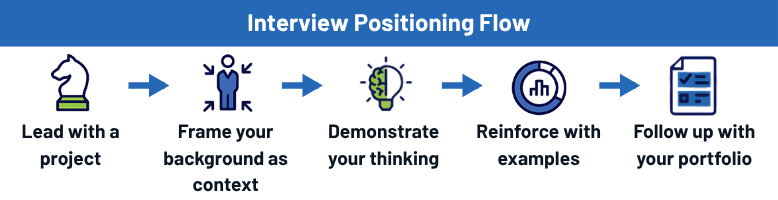
If you’re changing careers, use your previous experience to provide context. A nurse building a healthcare model understands the data differently than someone without that background. That’s an advantage.
Frame your path as a deliberate decision to learn by doing instead of treating it like a skills gap.
You should also expect to be tested. Technical assessments are common, but they become less intimidating when you’ve already worked through similar problems. Your portfolio becomes your preparation.
Still have questions about the best ways to prove your AI skills? See our FAQ below.
Prove Your Worth with GDH
You don’t need a PhD to break into AI. But you do need to be intentional about how you present your skills.
The candidates who get hired aren’t always the ones with the most credentials. They’re the ones who make their work easy to find, easy to understand, and easy to trust.
If you’re ready to connect with employers who hire based on demonstrated skill, not just degrees, join GDH’s talent network.

Frequently Asked Questions About Proving AI Skills
What AI projects impress hiring managers the most?
Hiring managers value projects that solve real business problems and include clear documentation. Projects involving forecasting, automation, recommendation systems, or natural language processing often demonstrate practical skills that transfer directly to workplace challenges.
Do employers care more about AI certifications or experience?
Most employers view certifications as supporting evidence rather than proof of ability. Hands-on projects, open-source contributions, and documented problem-solving typically carry more weight because they demonstrate how you apply AI concepts in real scenarios.
How many AI projects should be in a portfolio?
Quality matters more than quantity. Three to five well-documented projects that showcase different skills, such as data preparation, model development, deployment, and evaluation, usually make a stronger impression than dozens of unfinished examples.
What should an AI project README include?
A strong README explains the problem, dataset, methodology, results, and key decisions. It should allow a hiring manager to quickly understand the project’s purpose, your approach, and the value of the outcome.
Can you get an AI job with a bootcamp instead of a degree?
Yes, many employers now hire candidates from bootcamps and self-directed learning paths. Success depends on demonstrating practical skills, building a strong portfolio, and showing evidence that you can solve real-world AI problems.
What programming languages are most important for AI careers?
Python remains the most widely used language for AI and machine learning because of its extensive ecosystem. Knowledge of SQL, Java, or JavaScript can also be valuable depending on the role and deployment environment.
How long does it take to learn AI well enough for a job?
The timeline varies, but many candidates develop job-ready skills within six to twelve months of focused study and project work. Consistent practice and portfolio development often matter more than the specific learning path.
Is GitHub required for AI job seekers?
GitHub is not strictly required, but it is one of the most effective ways to showcase technical work. It gives recruiters and hiring managers a transparent view of your projects, code quality, and documentation skills.
What industries are hiring AI professionals without advanced degrees?
Technology, healthcare, financial services, retail, manufacturing, and logistics companies increasingly hire AI talent based on demonstrated skills. Many employers prioritize practical experience over academic credentials for applied AI roles.
Can freelance AI work help you get a full-time job?
Yes, freelance projects provide real-world experience that can strengthen your portfolio and resume. Even small engagements help demonstrate client communication, problem-solving ability, and the practical application of AI skills.
What are the most common mistakes AI job seekers make?
Common mistakes include building projects without documentation, relying solely on certifications, copying tutorials without customization, and failing to explain business outcomes. Employers want evidence of independent thinking and problem-solving.
How do you stand out in a competitive AI job market?
Focus on building unique projects, documenting your decision-making process, and highlighting measurable outcomes. Candidates who clearly communicate both technical skills and business impact often attract more attention from hiring managers.