

AI Hiring Demand in 2026: What the Data, Security, and Infrastructure Gaps Mean for Your Team
Quick Summary: AI engineers, cybersecurity specialists, and data infrastructure professionals remain some of the hardest IT roles to hire in 2026. As companies expand AI initiatives and strengthen cybersecurity programs, demand for specialized talent continues to outpace supply. Teams that align hiring plans with technology roadmaps are often better positioned to keep critical projects moving.
If it feels like important projects are waiting on talent before they can move forward, you’re not imagining it.
Over the past year, many IT leaders have found themselves balancing several major priorities at once. AI adoption has moved beyond experimentation. Security teams are responding to a growing list of threats and compliance requirements. Meanwhile, cloud modernization and data initiatives continue to demand specialized expertise.
Those efforts don’t happen in isolation. They often compete for the same people, which is one reason hiring timelines have stretched for some of the most in-demand technology roles.
The conversation has shifted as a result. Hiring isn’t just an HR concern anymore. For many organizations, workforce planning has become part of technology planning.
Why AI Talent Remains Difficult to Hire
A few years ago, most AI projects lived in innovation labs and pilot programs. Today, AI is showing up in products, customer experiences, internal workflows, and operational processes across the business.
As adoption expands, so does demand for the people who can build, deploy, secure, and manage these systems.
LinkedIn named AI Engineer the fastest-growing job in the United States in its 2026 Jobs on the Rise report, reflecting how quickly companies are investing in AI capabilities.
Demand, however, is only part of the story.
A Gartner analysis found that AI-related job postings across supply chain organizations increased 387% between early 2023 and early 2026. While the research focused on supply chain operations, the broader trend should feel familiar to most hiring managers. Demand for AI skills is growing faster than the talent pipeline.
Why the Talent Pipeline Is Under Pressure
The challenge isn’t simply finding people with machine learning experience. Many employers are looking for professionals who understand cloud platforms, data engineering, governance requirements, and security considerations in addition to AI.
That’s a difficult combination to find, particularly when experienced candidates often have multiple opportunities competing for their attention.
For hiring leaders, the practical takeaway is straightforward: AI-related roles are among the fastest-growing jobs in the U.S., and competition for experienced talent is likely to remain strong.

Why Cybersecurity Hiring Remains a Priority
While some technology hiring priorities shift with market conditions, cybersecurity remains remarkably consistent. Threats continue to evolve, regulatory expectations continue to grow, and leadership teams want greater visibility into cyber risk.
That combination keeps security talent in demand, even when other areas of technology experience hiring slowdowns.
The talent gap reflects that reality, but the more immediate issue is often skills alignment. ISC2 reports that 95% of respondents said their organizations have at least one cybersecurity skills need, and 59% described that skills gap as critical or significant. Only 5% said they are fully resourced with the cybersecurity skills they need.
Those numbers matter because security hiring isn’t a local competition anymore. Organizations are competing nationally and globally for many of the same skills.
The business impact can be significant; the average global data breach cost is $4.4 million per incident.
AI Is Creating New Security Challenges
Cybersecurity teams aren’t just protecting traditional systems anymore. As AI becomes more deeply embedded in business operations, security leaders are being asked to evaluate new risks and establish new controls.
Many organizations now need professionals who can secure AI-enabled systems, manage access controls, evaluate AI-related risks, and support governance efforts as AI adoption expands.
ISC2 reports that 34% of cybersecurity professionals say their organizations lack sufficient AI cybersecurity expertise.
IBM’s research points to a similar issue. The company found that 63% of organizations lack formal AI governance policies, creating additional exposure as AI use expands across the enterprise.
Security hiring has always been difficult. Adding AI expertise to the equation narrows the candidate pool even further.

Data and Infrastructure Talent Is Often the Real AI Bottleneck
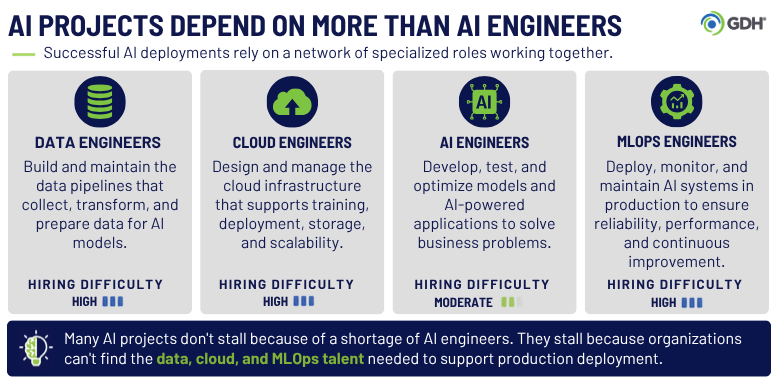
Ask a hiring manager where an AI project is most likely to get stuck, and many will point to the AI engineer role. In reality, some of the biggest bottlenecks appear further down the delivery chain.
AI projects rely on a network of supporting roles that rarely get the same attention but are just as critical to success.
Data engineers build the pipelines that feed AI models. Cloud engineers provide the infrastructure that supports training and deployment. MLOps professionals bridge the gap between development and production, helping teams deploy, monitor, and maintain AI systems after launch.
When one of those capabilities is missing, projects can slow down long before the AI team runs out of ideas.
That’s why some of the most important AI hiring decisions have little to do with AI titles at all. They’re about building the foundation that allows AI initiatives to move from experimentation into production.
The Growing Importance of MLOps
Among those supporting roles, MLOps has become particularly difficult to hire for. The position sits at the intersection of machine learning and operations, requiring expertise that typically develops across multiple disciplines.
These professionals help teams manage deployment pipelines, monitor model performance, and maintain production AI environments. Their work often determines whether an AI initiative becomes a business tool or remains a promising experiment.
For IT leaders planning AI investments, infrastructure and operational staffing deserve the same attention as AI engineering roles.
What Hiring Leaders Are Getting Wrong
Most hiring challenges in AI, cybersecurity, and infrastructure roles can be traced back to a handful of common mistakes:
Over-specifying Requirements
Job descriptions often ask for highly specialized experience that dramatically narrows the candidate pool. Candidates who could grow into a role may never apply because they don’t meet every listed requirement.
Using Outdated Compensation Benchmarks
Compensation expectations can move quickly in specialized technology markets. Salary data that worked a year ago may not be competitive today.
Treating Every Opening as a Permanent Hire
Some projects require long-term ownership. Others need specialized expertise for a specific initiative or implementation. Applying the same hiring model to every situation can create unnecessary delays.
None of these mistakes are unusual. They’re easy decisions to make when teams are under pressure to move quickly. They also happen to be some of the most common reasons hiring efforts stall.
How to Build a Hiring Strategy That Keeps Pace
One of the biggest shifts we’re seeing is how organizations think about staffing. Rather than defaulting to a single hiring approach, many are evaluating the work first and then determining the best way to build the team around it.
That flexibility is helping organizations move faster in a market where specialized talent remains difficult to find.
Match Talent Strategy to Initiative Stage
A proof of concept, a production deployment, and ongoing operational support all require different types of expertise.
Aligning staffing decisions with project maturity helps teams stay flexible and avoid delays caused by trying to solve every challenge the same way.
Hire for Adaptability and Communication
Technical skills matter, but they aren’t the only factor that determines success.
The strongest professionals can work across teams, communicate with stakeholders, and help keep projects moving when priorities change.
Those skills become especially valuable in AI, cybersecurity, and infrastructure projects where technical decisions often have business implications.
Bring Workforce Planning Into Roadmap Discussions Earlier
Timing plays a larger role in hiring success than many organizations realize. By the time a project is approved and a role is opened, teams are already working against the clock.
Bringing workforce planning into roadmap discussions earlier creates more options and reduces the likelihood of talent becoming a delivery bottleneck.
Leaders gain a better understanding of talent availability, hiring timelines, and potential gaps before those issues affect delivery.
That’s often the difference between reacting to staffing challenges and planning around them.
Technology leaders don’t need to approach every hiring challenge the same way. The most successful teams are aligning talent strategies with business priorities, technology roadmaps, and changing skill requirements.
GDH helps organizations build AI, cybersecurity, cloud, data, and infrastructure teams through flexible engagement models that align with business goals and project timelines.
Contact GDH today to start the conversation.