

How to Staff AI Initiatives Without Overhiring or Overpaying
Quick answer: Match your hiring to your AI maturity stage. Early-stage initiatives need a data engineer and a project-focused technical lead, not a full AI team. Use contract AI talent for time-bound builds and hire permanently only when you’ve proven sustained need. Then benchmark compensation quarterly against current market data.
The pressure to staff an AI initiative fast is understandable. What’s harder to see in the moment is that hiring mistakes don’t show up on the budget until months later, and by then they’re already expensive to unwind. The organizations that avoid those traps prioritize deliberation over speed.
The key to getting your AI hiring strategy right means knowing which roles belong in which phase and how to keep compensation competitive without letting costs run ahead of value. It also means recognizing when contract talent is the better call.
Which AI Roles Matter at Each Stage of Your Initiative
The most expensive AI staffing mistake is hiring for the steady state before you’ve proven the use case. At the early stage, your two highest-leverage hires are a data engineer who can audit and consolidate your data pipelines, and a technical project lead who keeps the work tied to a specific business outcome.
Everything else comes after you know what you’re building and whether the data can support it.
From there, the right roles depend on where you are in the initiative lifecycle.
- Proof of concept (0–6 months). You need someone who can assess data readiness, prototype quickly, and tell you what’s viable. A senior data engineer or machine learning engineer on a contract basis covers this phase without the overhead of a permanent hire.
- Pilot and validation (6–18 months). Once you have something working in a controlled environment, you need an ML engineer or applied AI specialist to make it production-ready, and an analyst to measure whether it’s producing real results.
- Scale and optimization (18+ months). This is where permanent hires start making economic sense. You’ve proven demand, you understand the ongoing work, and you have enough context to write an accurate job description.
The most common early-stage error is hiring a data scientist before the data infrastructure exists to support modeling. A data scientist without clean, accessible data produces unreliable outputs and eventually leaves.
Building the infrastructure first costs less than repairing the damage of skipping it.
When AI Talent Costs Less on a Contract Basis
The AI talent costs for permanent roles have risen sharply. Wages are rising twice as fast in industries most exposed to AI compared to those least exposed, signaling that AI talent premiums are accelerating broadly, not just in tech.
A significant portion of that demand reflects temporary capability gaps that companies are staffing as if they’re permanent needs, and that mismatch is where budgets get away from leaders.
Project-based or contract AI talent makes sense in several specific situations.
- You have a defined deliverable. A model build, a data pipeline migration, or a vendor integration has a start and an end. Carrying permanent headcount after the work is done turns a project cost into a structural one.
- You’re evaluating a technology before committing. A contract ML engineer who can assess whether a platform fits your environment costs far less than hiring permanently and discovering six months in that it doesn’t.
- You need a skill that won’t be needed continuously. Prompt engineering, fine-tuning, and AI model evaluation are critical during a build sprint and rarely needed at the same intensity after deployment.
The real risk with project talent is fragmented institutional knowledge. The fix is good documentation standards and a structured handoff process, both of which you should require before any project-based engagement begins. Once a function becomes part of daily operations, convert it to a permanent role. That decision point is worth scheduling explicitly, not leaving to chance.

How to Avoid Common AI Hiring Strategy Mistakes
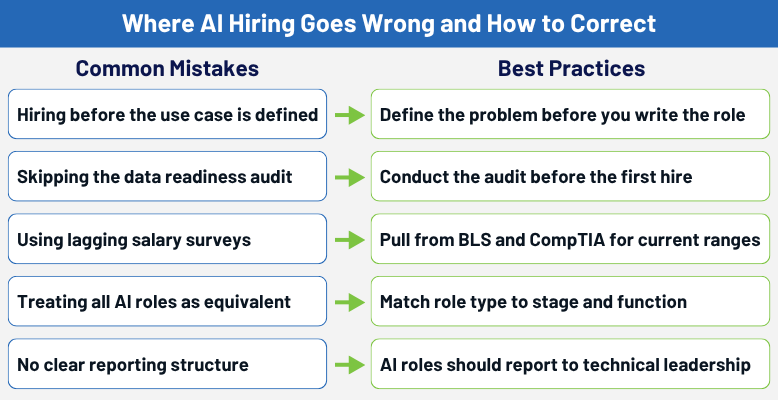
When leadership is anxious that competitors are moving faster on AI, leaders under that pressure write job descriptions that don’t connect to a coherent use case. That’s how you end up with a Head of AI Innovation whose mandate could mean almost anything, and whose first six months get spent defining a role that should have been defined before the hire was made.
A few patterns show up repeatedly in organizations that struggle with AI workforce planning:
- Writing job descriptions based on vendor demos. Vendors show you the ceiling. Your job description should reflect where your data and infrastructure are, not where you hope they’ll be in two years.
- Treating AI engineers and data scientists as interchangeable. A data scientist builds models; a data engineer builds the systems that feed those models. Both roles matter, but they belong at different stages and they’re not substitutes for each other.
- Skipping the data readiness audit. Before you hire anyone for AI initiatives, someone needs to honestly assess whether your data is clean, accessible, and structured in a way that supports modeling. This audit belongs at the front of the process.
- Setting compensation without current market data. Broad salary surveys often lag 12 to 18 months behind the real market. Use sources like the BLS Occupational Employment and Wage Statistics or CompTIA’s State of the Tech Workforce when building your ranges.
One structural issue rarely gets examined until something goes wrong: AI roles need to report to someone who can evaluate the technical work. When engineers report up through a function that can’t assess output quality, problems accumulate quietly for a long time before they surface.
How AI Workforce Planning Keeps Costs Under Control
AI workforce planning isn’t something you do once during budget season. The market shifts fast enough that a compensation structure from 18 months ago is almost certainly below what candidates expect today. The gap shows up first in offer rejections and then in turnover.
The following practices help keep AI talent costs manageable without the loss of good people.
- Quarterly compensation benchmarking. Pull current data from BLS, CompTIA, or a staffing partner with real placement data in your market. Adjust before you lose someone, not after you’ve posted the backfill.
- Tiered team structures. A senior AI architect doesn’t need to own every part of the stack. Pair senior specialists with mid-level engineers who handle implementation and maintenance. The senior hire sets direction; the mid-level hire scales the work at a lower cost per hour.
- Shared services for low-frequency needs. AI security review, responsible AI auditing, and model governance support are periodically critical but rarely full-time. A managed services arrangement covers those needs at a fraction of the headcount cost.
Companies with structured AI workforce planning processes report 38% lower voluntary turnover among technical staff than those hiring reactively, according to CompTIA’s State of the Tech Workforce 2024. That retention gap translates directly into lower recruiting costs and faster time-to-productivity for new hires.

Build Your AI Team With the Right Fit for Each Stage
The companies doing AI staffing well aren’t the ones with the biggest teams. They’re the ones where every role has a clear owner, a defined scope, and a measurable purpose.
If you’re building your AI hiring strategy and want a partner who understands both the technical requirements and the business case behind each hire, let’s talk. We work with technology leaders at every stage of AI maturity. Contact GDH to talk through your staffing needs.