

Best Practices for Building App Development Teams: A Guide to Hiring Well Across All Required Roles
Quick answer: Building an app development team requires more than hiring developers. The most effective app dev hiring strategy maps software development roles to your team’s current stage, starting with architecture and platform before scaling front-end and back-end capacity. Sequence matters as much as headcount.
You have budget approval and a real initiative on the calendar. Now you’re staring at a roster question with no obvious starting point: Who do you hire first, and in what order?
Most technology leaders have managed engineers before. But standing up or scaling an app development team from scratch is typically a different kind of IT staffing challenge. Role titles overlap, seniority signals get misread, and a mis-sequenced hire compounds costs in ways that don’t show up until months later.
More headcount won’t fix a team that’s misaligned. The teams that deliver strong results are the ones that got the structure right early. They knew which roles needed to be in place from the start and which ones could wait.
The Roles Every App Development Team Needs
A complete app development team covers five functional areas: architecture and planning, front-end and user experience, back-end services and data, quality assurance, and delivery operations. Each area requires different skills, and not every role needs to be a full-time hire on day one.
Some roles belong on the team from day one; others scale with the work.
Solutions or Enterprise Architect
This role defines how the system fits together before a line of code is written. Architects make decisions about technology stack, integration patterns, and long-term scalability that every other hire will live with.
Back-End Developer
Back-end engineers build the server-side logic, APIs, and data layer that the product runs on. They work closely with architects and are typically among the first hires after structure is in place.
Front-End Developer
Front-end developers build what users see and interact with. Depending on project complexity, this role may start as a contract engagement until the interface requirements stabilize.
Full-Stack Developer
Full-stack engineers can work across both front-end and back-end layers, which makes them valuable on smaller teams or during early phases when flexibility matters more than specialization.
Mobile Developer
If your product includes a mobile app, mobile engineers are a specialized hire. iOS and Android skill sets overlap less than many hiring managers expect.
QA/Test Engineer
Quality assurance is one of the most commonly deferred hires and one of the costliest mistakes. QA engineers catch defects before they reach production, where they are orders of magnitude more expensive to fix.
DevOps or Platform Engineer
This role owns the build, deployment, and infrastructure pipeline. Without it, developers spend time on operations work instead of product development.
Product Owner or Technical PM
Someone has to translate business requirements into prioritized, actionable work for the team. Whether this is a product owner, a technical program manager, or a senior developer in a hybrid role depends on your organization, but the function must exist.
UX Designer
UX is often treated as optional in early-stage builds. Poor UX generates rework and user abandonment that earlier investment prevents.
Sources: GDH internal hiring guidance; BLS Occupational Outlook Handbook
Understanding which roles belong at which stage is the first step. The harder question is what order to hire them in.

How to Sequence Your App Dev Hiring
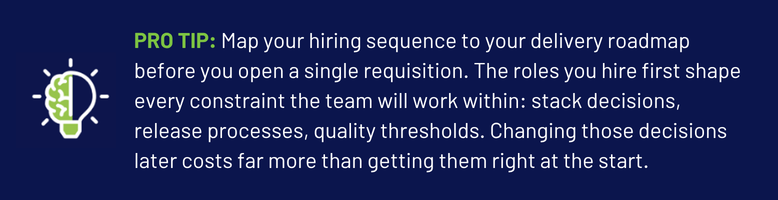
Sequencing is the part most organizations get wrong. The instinct is to front-load developer headcount and figure out the rest later. In practice, that approach creates structural debt that slows every team you add afterward.
Start with Architecture and Planning
Before significant development begins, two roles earn their keep immediately: the architect and the product owner. The architect makes foundational decisions about technology stack and system design that every subsequent hire will build on.
The product owner ensures there’s a clear, prioritized backlog before engineers start writing code. Without these two in place, developers either wait or build in directions they’ll later have to undo.
Bring QA In During Development, Not After
Once architecture and requirements are grounded, hire the back-end developers who will build the core services your product runs on. Front-end and full-stack hires typically follow, sequenced by what the roadmap demands first.
Bring QA in at this stage also; don’t wait for the first release. Defects cost exponentially more to fix after code reaches production than when caught early.
Poor software quality cost the U.S. economy at least $2.41 trillion in 2022, with accumulated technical debt accounting for roughly $1.52 trillion of that total. A large portion of that cost traces back to defects that weren’t caught until late in the development lifecycle, which is exactly why QA sequencing matters.
Address Infrastructure Before It Becomes a Problem
Teams often assume developers will handle infrastructure informally until headcount increases. What actually happens is that your most expensive engineers spend a meaningful share of their time on deployment and environment work.
A DevOps engineer hired during the scaling phase is free to focus on product. This can prevent infrastructure decisions made under pressure from becoming permanent liabilities.
Specialize as Volume Increases
As the team grows, full-stack generalists can be complemented by dedicated front-end and back-end engineers. A mobile developer enters the picture if the product includes a native app. UX, if it started as a shared or contract resource, often moves to a dedicated role. QA capacity should grow in proportion to development throughput, not as a reaction to it.
Shift Architecture Toward Governance at Maturity
In a mature team, the architect’s focus moves from design decisions to standards, consistency, and cross-team alignment. Senior technical PMs often become critical here, coordinating across workstreams that a smaller team never needed to formalize.
Architecture, QA, and DevOps aren’t roles you add when things get complicated. They’re what keeps things from getting complicated.
CISQ estimated poor software quality cost the U.S. economy at least $2.41 trillion in 2022, the most recent data available. That figure has continued to grow since.
A large portion of that cost traces back to defects that weren’t caught early in the development lifecycle.

Common Hiring Mistakes in App Dev Staffing
Even experienced tech leaders make predictable errors when building app dev teams. Most stem from treating hiring as a technology staffing exercise rather than a structural decision.
Hiring for Today’s Stack Instead of Tomorrow’s Requirements
A developer who’s expert in the current framework may not be the right fit if your architecture is evolving. Define where the system needs to go in 18–24 months and hire toward that trajectory, not just the immediate backlog.
Conflating Seniority Levels
Senior engineer, staff engineer, and principal engineer are not interchangeable titles. Misaligning seniority to the actual scope of the role creates frustration on both sides and produces turnover that’s expensive to recover from.
Skills-based hiring offers a more reliable framework for evaluating candidates beyond titles and years of experience.
Posting Before the Role Is Defined
A job description that conflates responsibilities or uses placeholder language will attract the wrong candidates and slow your hiring timeline. Senior application developer roles already take about 20% longer to fill than standard ones, and that gap widens when the spec is unclear.
Defining the role well starts with employer branding. How you describe the work shapes who applies.

Defaulting to One Employment Model
Contract hires offer speed and flexibility for well-scoped work. Full-time makes sense when the role requires deep institutional knowledge or long-term product ownership. Deciding which model fits which role before you open the requisition avoids a mid-search pivot that costs everyone time.
Treating QA and DevOps as Deferred Hires
Teams that push quality and operations roles to a later phase almost always spend more fixing problems than they would have spent hiring those functions earlier.
How GDH Helps You Build App Development Teams
GDH specializes in IT staffing for organizations at every stage of team growth.
Building an app development team is a sequencing problem as much as a talent problem. If you’re standing up or expanding your app dev function, connect with GDH to start the conversation.

FAQ
What roles are needed for an app development team?
A complete team needs a solutions architect, front-end and back-end developers, QA/test engineer, DevOps or platform engineer, and a product owner or technical PM. Mobile developer and UX designer depend on scope.
How many developers do you need to build an app?
Early-stage teams often run effectively with two to four developers supported by an architect and a QA engineer. That number shifts once mobile, multiple front-end frameworks, or high-availability infrastructure enter the picture.
What’s the difference between a front-end and full-stack developer?
Front-end developers focus on the user interface. Full-stack developers work across both front-end and back-end layers. Full-stack offers flexibility on small teams; front-end specialists add depth on complex UI work at scale.
When should I hire a DevOps engineer?
Earlier than most teams do. If your developers are managing deployments or CI/CD pipelines, you’re paying engineering salaries for operations work and locking in infrastructure decisions that are expensive to undo.
Should I hire contract or full-time developers?
Contract works well for defined scope and faster ramp times. Full-time fits roles requiring long-term product ownership or deep institutional knowledge. Contract-to-hire is a useful bridge when fit is uncertain.
How long does it take to staff a software development team?
Standard roles average around 41 days to fill; senior roles run longer. Building a team means accounting for that timeline across multiple concurrent requisitions, not treating each hire as sequential.
What does a solutions architect do on an app dev team?
A solutions architect designs the technical structure: stack, integration patterns, data models, and scalability. Bringing one in after significant development has started usually means retrofitting decisions that should have been made first.
References
Bureau of Labor Statistics, U.S. Department of Labor. (2024). Software developers, quality assurance analysts, and testers. Occupational Outlook Handbook. https://www.bls.gov/ooh/computer-and-information-technology/software-developers.htm
Chamberlain, A. (2017). How long does it take to hire? Interview duration in 25 countries. Glassdoor Economic Research. https://www.glassdoor.com/blog/time-to-hire-in-25-countries/
Consortium for Information & Software Quality. (2022). The cost of poor software quality in the US: A 2022 report. https://www.it-cisq.org/the-cost-of-poor-quality-software-in-the-us-a-2022-report/
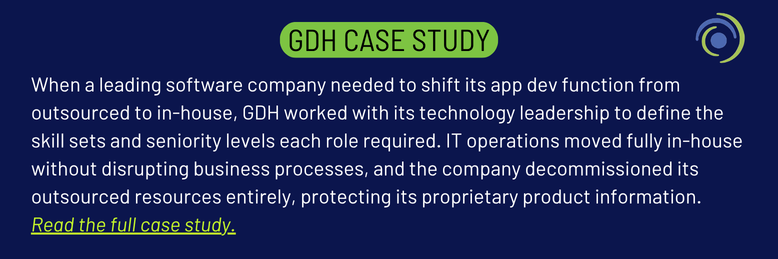
GDH. (n.d.). Software company shifts from outsourced to in-house hiring model [Case study]. https://gdhinc.com/case-study/software-company-shifts-from-outsourced-to-in-house-hiring-model/
Pluralsight. (2024). Hire or upskill? The cost of tech industry skill development. https://www.pluralsight.com/resources/blog/business-and-leadership/tech-industry-skill-development